Table of Contents

Understanding the Ayurveda Circadian Rhythm: Essential Knowledge for Micro Health Planning

Understanding the Ayurveda Circadian Rhythm is Essential for Micro Health Planning. The Ayurveda Circadian Rhythm is closely related to the principles of bodily humors (Dosha) mentioned in Ayurveda. It highlights the fluctuations of these humors based on factors such as age, the daily cycle, food intake, and the process of digestion.
वयोऽहोरात्रिभुक्तानां तेऽन्तमध्यादिगाः क्रमात् ।
“Vayo’horatribhoktanam Te’ntamadhyadigah Kramat”
Understanding the Ayurveda Circadian Rhythm is Essential for Micro Health Planning. Ayurveda, the ancient science of life, is dedicated to promoting health, longevity, and disease prevention through a balanced lifestyle. It classifies human life into various stages based on physiological changes and biological rhythms. The Sanskrit verse:
“वयोऽहोरात्रिभुक्तानां तेऽन्तमध्यादिगाः क्रमात्।”
translates to “The classification of age, day-night cycles, and meals follows the sequence of beginning, middle, and end.”
This verse signifies the systematic categorization of life stages (Vaya), daily cycles (Ahoratri), and food intake (Bhukta) according to their natural order. Let’s explore these three aspects in detail.
Vaya (Stages of Life)
Understanding the Ayurveda Circadian Rhythm is Essential for Micro Health Planning. Ayurveda divides human life into three major stages, each governed by a dominant Dosha (biological energy):

Childhood (Balyavastha)
0 to 16 years (Kapha-dominant phase)
This stage is characterized by rapid growth, nourishment, and tissue development.
Dependence on parents for survival and care. High requirement for nutritious food to support bodily growth. Light, warm, and easily digestible foods are recommended to balance Kapha.
This is the naturally occurring Kapha-dominant phase of human life.
Adulthood (Madhyamavastha)

16 to 60 years (Pitta-dominant phase)
Understanding the Ayurveda Circadian Rhythm is Essential for Micro Health Planning. The phase of maximum physical strength, intelligence, and productivity.
High metabolic rate, strong digestion, and active lifestyle.
Proper diet, exercise, and mental balance are crucial.
Excessive stress, spicy food, and overwork can lead to Pitta imbalances like acidity and hypertension.
This is the naturally occurring Pitta-dominant phase of human life.
Old Age (Jara-avastha)

60 years onwards (Vata-dominant phase)
Understanding the Ayurveda Circadian Rhythm is Essential for Micro Health Planning.
Declining physical strength, weakening tissues, and fragile bones.
Increased chances of joint pain, dryness, and neurodegenerative issues. Need for nourishing, warm, and easily digestible food.
Practices like oil massage (Abhyanga), meditation, and social engagement help maintain well-being.
This is the naturally occurring Vata-dominant phase of human life.
Ahoratra
(Daily Rhythms – Day and Night Cycles)
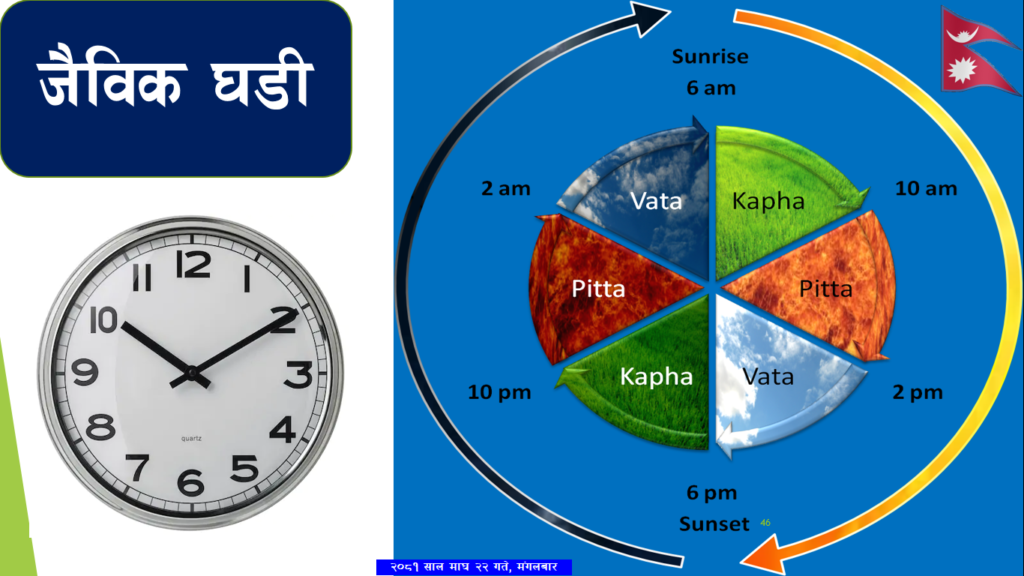
Understanding the Ayurveda Circadian Rhythm is Essential for Micro Health Planning. The Ayurveda concept of the circadian rhythm of Dosha with meal is divided into three phases, aligned with the biological clock of the body:
Morning
Morning is the naturally occurring Kapha-dominant phase of human body.

Afternoon
Afternoon is the naturally occurring Pitta-dominant phase of human life.
Evening
Evening is the naturally occurring Kapha-dominant phase of human life.

Bhukta
(Stages of Ingestion/Digestion/Assimilation/Metabolism/Excretion)
Understanding the Ayurveda Circadian Rhythm is Essential for Micro Health Planning. Ayurveda classifies food intake into three stages to align with digestion:
Ingestion Phase (Aadi) – Kapha Phase
There is Dominance of Kapha Dosha immediately after taking meal
Digestion Phase (Madhya) – Pitta Phase
Understanding the Ayurveda Circadian Rhythm is Essential for Micro Health Planning. Digestion and metabolism are at their peak during the mid of the meal.
Metabolism & Excretion (Anta) – Vata Phase
Understanding the Ayurveda Circadian Rhythm is Essential for Micro Health Planning. The body prepares for rest and recovery. After Digestion there is assimilation of nutrients to tissues and cells and this is phase of production of waste products like Carbon dioxide, stool and urine.
Conclusion
The verse “Vayo’horatribhoktanam Te’ntamadhyadigah Kramat” provides a scientific framework for understanding the stages of life, daily biological rhythms, and optimal eating patterns.
Life is divided into Kapha, Pitta, and Vata phases.
Day and night follow a natural cycle that affects bodily functions.
Eating habits should align with digestive capacity for optimal health.
By adopting Ayurvedic lifestyle principles, one can achieve longevity, well-being, and disease prevention. This ancient wisdom is now being validated by modern research, reinforcing Ayurveda’s timeless relevance.
“Swasthasya Swasthya Rakshanam, Aturasya Vikara Prashamanam.”
(Preserve the health of the healthy and treat the ailments of the diseased.)
This remains Ayurveda’s ultimate goal, which can be realized through mindful living and adherence to nature’s rhythms.
Can you imagine how many people in the world are aware of the Ayurveda Circadian Rhythm and follow it to maintain their health? This is why the Medical Director of Aatreya Aarogya Mandir and Research Center Dr. Buddhi Prasad Paudel advocates for the incorporation of Ayurveda lifestyles into the curricula of schools and universities to prevent non-communicable diseases (NCDs) and promote good health and longevity.