
Table of Contents

Aajapajapa Mantra helps an individual efficiently manage daily life, cultivate awareness of Time, Place, and Person, and develop the habit of self-reflection.
The Ajapajapa Mantra holds a significant place in the Vedic tradition, serving as a powerful spiritual practice that aligns daily life with purity, sattvic energy, and higher consciousness. This article explores its structure, meaning, spiritual benefits, and practical application in daily life.
Structure and Explanation of the Mantra
Aajapajapa Mantra helps an individual efficiently manage daily life, cultivate awareness of Time, Place, and Person, and develop the habit of self-reflection.
Aajapajapa Mantra helps an individual efficiently manage daily life, cultivate awareness of Time, Place, and Person, and develop the habit of self-reflection.
(1) Invocation and Core Mantra
The mantra begins with:
“ॐ विष्णवे नमः, ॐ विष्णवे नमः, ॐ विष्णवे नमः।”
This phrase carries profound meaning:
‘ॐ’ (Om) – The primordial sound, representing universal consciousness and the essence of existence.
‘विष्णवे’ (Vishnave) – Invocation of Lord Vishnu, the sustainer of creation and protector of Dharma.
‘नमः’ (Namah) – A gesture of surrender and devotion.
This initial invocation helps align the practitioner’s consciousness with divine vibrations.
Cosmic Time, Astronomical Calculations and Geography
Aajapajapa Mantra helps an individual efficiently manage daily life, cultivate awareness of Time, Place, and Person, and develop the habit of self-reflection.
The second part of the mantra defines the cosmic time and the present era:
“ॐ अद्य ब्रह्मणोऽह्नि द्वितीयपरार्धे श्रीश्वेतवाराहकल्पे वैवस्वतमन्वन्तरेऽष्टाविंशतितमे कलियुगे कलिप्रथमचरणे बौद्धावतारे”
This includes:
‘अद्य ब्रह्मणोऽह्नि’ (Adya Brahmaṇo’ahni) – The current day of Lord Brahma.
‘द्वितीयपरार्धे’ (Dvitīya-parārdhe) – The second half of Brahma’s 100-year lifespan.
‘श्रीश्वेतवाराहकल्पे’ (Śvetavārāha-kalpe) – The current Kalpa (Śvetavārāha Kalpa).
‘वैवस्वतमन्वन्तरे’ (Vaivasvata-manvantare) – The present Manvantara (Vaivasvata, the seventh Manu).
‘अष्टाविंशतितमे कलियुगे’ (Aṣṭāviṁśati-tame Kaliyuge) – The 28th cycle of the Kali Yuga.
‘कलिप्रथमचरणे’ (Kali-prathama-caraṇe) – The first phase of Kali Yuga.
‘बौद्धावतारे’ (Bauddha-avataré) – The era marked by Lord Buddha’s incarnation.
The mantra then specifies geographical coordinates:
“भूर्लोके जम्बूद्वीपे भरतखण्डे भारतवर्षे नेपाल काठमाडौं क्षेत्रे बुढानीलकण्ठ नगरे कपन ग्रामे”
This describes:
‘भूर्लोके’ (Bhūrloke) – The earthly realm.
‘जम्बूद्वीपे’ (Jambūdvīpe) – The Jambu Dvīpa (ancient name for the Indian subcontinent).
‘भरतखण्डे’ (Bharatakhaṇḍe) – The land of King Bharata.
‘नेपाल’ (Nepāl) – The specific nation.
‘काठमाडौं क्षेत्रे’ (Kathmandu Kṣetre) – The city or region.
‘बुढानीलकण्ठ नगरे कपन ग्रामे’ (Buḍhānīlakaṇṭha Nagare Kapan Grāme) – The locality or village.
This cosmic and geographical positioning helps the practitioner situate themselves in time and space before performing spiritual activities.
Personal Identity, Time, and Purpose of Action
Aajapajapa Mantra helps an individual efficiently manage daily life, cultivate awareness of Time, Place, and Person, and develop the habit of self-reflection.
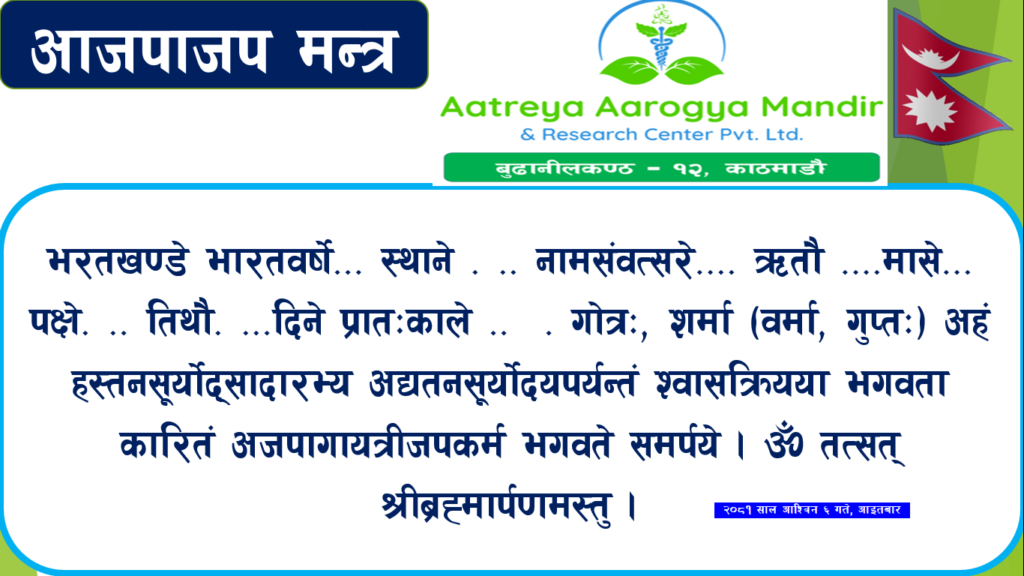
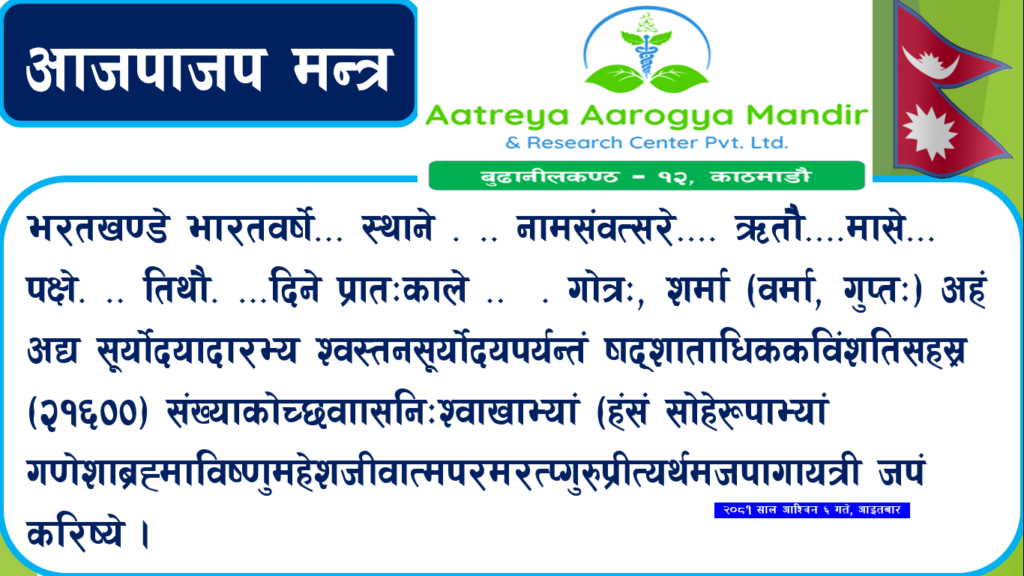
“पिंगल नाम-संवत्सरे फाल्गुन मासे शुक्लपक्षे तृतीय तिथौ रविवासरे”
This part includes:
‘पिंगल नाम-संवत्सरे’ (Piṅgala Nāma-Saṁvatsare) – The current Vedic year cycle (Piṅgala).
‘फाल्गुन मासे’ (Phālguna Māse) – The lunar month (Phālguna).
‘शुक्लपक्षे तृतीय तिथौ’ (Śukla-pakṣe Tṛtīya Tithau) – The lunar phase (third day of the waxing moon).
‘रविवासरे’ (Ravivāsare) – The day of the week (Sunday).
“आत्रेय गोत्रः आत्रेय गोत्रः आत्रेय गोत्रः डा बुद्धि प्रसाद पौडेलऽहम्”
This part establishes the personal identity of the practitioner
Aajapajapa Mantra helps an individual efficiently manage daily life, cultivate awareness of Time, Place, and Person, and develop the habit of self-reflection.
‘आत्रेय गोत्रः’ (Ātreya Gotraḥ) – The practitioner’s Vedic lineage (Ātreya Gotra).
Name (Dr. Buddhi Prasad Paudel) – The person performing the ritual.
“प्रातः (मध्याह्ने, सायं) सर्वकर्मसु शुद्ध्यर्थं श्रुतिस्मृतिपुराणोक्तफलप्राप्त्यर्थं श्रीभगवत्प्रीत्यर्थं च अमुक कर्म करिष्ये।”
This section specifies the purpose
Aajapajapa Mantra helps an individual efficiently manage daily life, cultivate awareness of Time, Place, and Person, and develop the habit of self-reflection.
‘प्रातः (मध्याह्ने, सायं)’ – The time of practice (morning, midday, or evening).
‘सर्वकर्मसु शुद्ध्यर्थं’ – For the purification of all actions.
‘श्रुतिस्मृतिपुराणोक्तफलप्राप्त्यर्थं’ – To attain results prescribed in the Vedas, Smritis, and Puranas.
‘श्रीभगवत्प्रीत्यर्थं’ – For the pleasure of the Supreme Lord.
‘अमुक कर्म करिष्ये’ – Declaration of a specific action to be performed.
Significance of the Ajapajapa Mantra
Aajapajapa Mantra helps an individual efficiently manage daily life, cultivate awareness of Time, Place, and Person, and develop the habit of self-reflection.
(1) Spiritual Benefits
Enhances inner peace, focus, and clarity
Aligns personal consciousness with cosmic energy.
Strengthens one’s willpower and commitment to spiritual practice.
(2) Health and Psychological Well-being
Reduces stress and anxiety.
Improves mental concentration and mindfulness.
Helps maintain a rhythmic balance in the nervous system.
(3) The Role of Karma and Vedic Tradition
Ensures that all actions are performed with purity and divine intention.
Establishes a conscious connection between personal actions and cosmic order.
Practical Application of the Mantra
Aajapajapa Mantra helps an individual efficiently manage daily life, cultivate awareness of Time, Place, and Person, and develop the habit of self-reflection.
(1) Daily Practice (Nitya Karma)
Recite the mantra in the morning, midday, or evening.
Perform it after bathing, in a clean and sacred space.
(2) Before Special Activities
Chant before beginning any spiritual, medical, or service-oriented work.
Ideal for rituals, prayers, and meditative practices.
(3) During Meditation and Spiritual Disciplines
Helps deepen meditation and self-awareness.
Should be chanted with full concentration and devotion.
Conclusion
Aajapajapa Mantra helps an individual efficiently manage daily life, cultivate awareness of Time, Place, and Person, and develop the habit of self-reflection.
The Ajapajapa Mantra is not just a religious chant but a scientific, spiritual, and cultural practice rooted in the Vedic tradition. By aligning an individual’s consciousness with universal time, space, and divine will, this mantra purifies thoughts, actions, and intentions.
Regular practice can lead to personal transformation, enhanced well-being, and a profound connection with the cosmos and the divine.
Thus, incorporating this mantra into daily life can bring peace, clarity, and a deeper sense of purpose for both individuals and society.