Veda: An Introduction
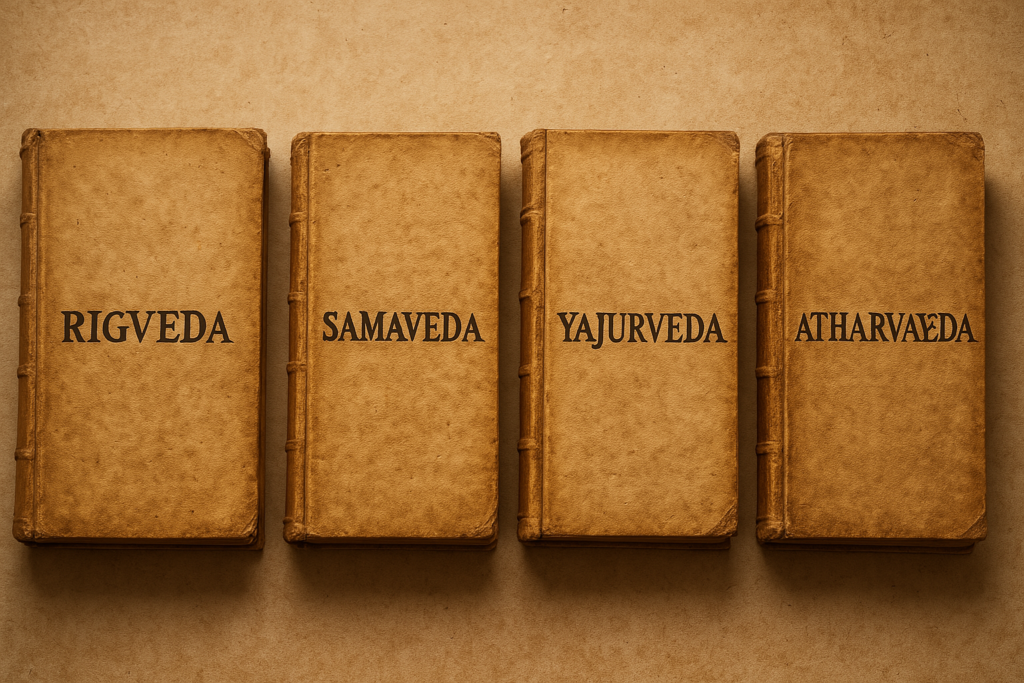
Table of Contents

The Veda are the foundational scriptures of Sanatana Dharma (Hinduism). The word comes from the Sanskrit root vid, meaning “to know.” Thus, the Vedas are considered the eternal source of knowledge. They are classified as Shruti (that which is heard), signifying wisdom transmitted orally through the Guru–disciple tradition. These scriptures are believed to be apaurushya (not of human origin) and Nitya (eternal).
Types
There are four types:
Rigveda
The oldest of all.
It contains hymns, praises, and invocations to various deities.
Divided into 10 mandalas (books), comprising around 10,580 verses.
Yajurveda
Focused on rituals and sacrificial ceremonies.
Divided into two major recensions: Shukla (White) and Krishna (Black).
Provides mantras and guidelines for performing yagya (rituals).
Samaveda
Consists mostly of hymns from the Rigveda, set to musical notes.
Forms the foundation of Indian classical music and chanting tradition.
Atharvaveda
Contains knowledge related to daily life, healing, psychology, and spirituality.
Deals with medicine, rituals, spells, and social practices.
Structure
Each Scripture is divided into four parts:
Samhita
The core hymns or mantras.
Brahmana
Ritualistic explanations and procedures.
Aranyaka
Texts for forest-dwellers; meditative and symbolic content.
Upanishad
Philosophical discourses on the nature of the self (Atman) and ultimate reality (Brahman).
Importance
Philosophical Depth
The Upanishads explore metaphysical concepts like self, soul, liberation, and the absolute.
Scientific Insights
The scriptures’ contain references to astronomy, mathematics, medicine, and acoustics.
Spiritual Evolution
Spiritual teachings guide an individual toward self-realization and union with the Supreme.
Health and Medicine
The Atharvaveda lays the foundation of Ayurveda and holistic healing.
Cultural and Social Framework
These Scriptures outline rituals, ethics, and values that shape Vedic society, including the 16 Samskara (life sacraments).
Preservation and Transmission
These scriptures have been preserved orally for millennia through the meticulous recitation systems of śruti tradition. Accuracy of pronunciation, intonation, and meter is vital. Great scholars like Panini, Yaska, Sayana, and Maitreyi contributed extensively to the interpretation and expansion of Vedic knowledge.
Conclusion
These oldest scriptures are not just religious texts; they are encyclopedic in nature, encompassing science, spirituality, psychology, health, and society. Even in modern times, the Vedas remain relevant—not only as spiritual guides but also as deep wells of human wisdom. Their holistic vision of life offers a timeless path to balance, wellness, and inner realization.
Pancha Papa, Pancha Yagya & Six limbs
The Vedic Sanatana Sanskriti is not merely a system of rituals but a complete philosophy of life. It offers a profound guide for righteous living, moral conduct, spiritual progress, and societal harmony. Among its many teachings, the concepts of the Five Sins (Pancha Pāpa), Five Yagya (Pancha Yagya), and the Six Limbs of the Vedas (Ṣaḍanga Vedaṅga) hold special importance. These elements together form a foundational structure for Vedic life and self-realization.
The Five Sins (Pancha Papa)
These are the five gravest sins according to this tradition. Committing these acts is considered highly immoral and spiritually degrading. They are:
Brahmahatya
Killing a Brahmin or a knower of sacred wisdom.
Surspana
Consumption of intoxicating or alcoholic substances.
Steya (Theft)
Stealing or taking what is not rightfully yours.
Guru-patni-gamana
Engaging in illicit relations with the wife of one’s teacher or guru.
Suvarnasteya
Theft of valuable items like gold, especially from Brahmins or temples.
These sins are seen not just as personal faults but as serious violations against society, dharma, and the spiritual order. Scriptures also prescribe penance and atonement rituals for these.
The Five Yagya (Pancha Maha Yagya)
The Five Yagya are daily duties prescribed in the Vedic way of life. They represent the moral and spiritual responsibilities one must fulfill to repay the debts owed to various entities.
Brahma Yagya
Study, recitation, and teaching of the scripturas; honoring knowledge and the teacher.
Deva Yagya
Worship and offerings to the deities through rituals like Agnihotra or Homa.
Pitri Yagya
Honoring ancestors through śrāddha, tarpaṇa, and remembrance rituals.
Bhuta Yagya
Offering food and kindness to animals, birds, and the environment.
Aatithi (Manushya) Yagya (Atithi Yajña)
The Six Limbs (Shadanga Vedanga)
Serving guests, the needy, and performing humanitarian service.
These yajñas help maintain harmony between the individual and the universe — covering the divine, ancestral, natural, and social realms.
To properly study, understand, and preserve the Vedas, six auxiliary sciences called Vedāṅgas are essential. Each limb serves a unique purpose in preserving the phonetic, grammatical, ritualistic, and astronomical precision of Vedic knowledge.
Shikshya
Phonetics and pronunciation; governs articulation, intonation, and clarity.
Kalpa
Ritual rules; instructions for conducting rituals and ceremonies (Gṛhya, Śrauta Sutra).
Vyakarana
Grammar; primarily based on Pāṇini’s system, ensures proper usage of language.
Nirukta
Etymology; explains difficult words in scriptures and their origins.
Chhanda
Prosody or meter; governs rhythm and structure of Vedic hymns.
Jyotish
Astronomy and astrology; used to determine proper timing for rituals and festivals.
Without the limbs, Vedic study can become inaccurate or misunderstood. These six limbs act as a scientific and linguistic foundation for scriptural practice.
Conclusion
The Five Sins warn us against moral downfall. The Five Yagya guide us toward fulfilling our spiritual, social, and cosmic duties. The Six Limbs of the Vedas provide the structure necessary to preserve and understand sacred knowledge. Together, they offer a holistic framework for a balanced and dharmic life—leading one toward Dharma (righteousness), Artha (prosperity), Kama (fulfillment), and Mokṣa (liberation).